

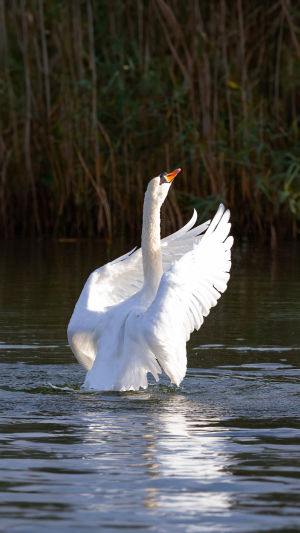
Gliding across a calm lake, swans exude a calm elegance that captures anyone's attention. Their long necks curve gracefully, and their wings catch the light in soft, majestic arcs.
Observing swans in their natural environment reveals a fascinating mix of social bonds, behaviors, and surprising intelligence that goes far beyond their beauty.
<h3>Distinctive Features and Identification</h3>
Swans are among the largest waterfowl, easily recognized by their long necks, broad wings, and striking plumage. Most species are white, though some, like the black swan, display dark feathers.
<b>1. Neck and posture:</b> Their long necks allow them to reach underwater vegetation while maintaining an elegant silhouette above water. Observing a swan dipping gracefully to forage demonstrates both its physical adaptations and aesthetic charm.
<b>2. Beak coloration:</b> The color and shape of a swan's beak can help identify the species. For instance, a bright orange beak often signals a mute swan, while a black beak might indicate a trumpeter or black swan.
<b>3. Size and wingspan:</b> Swans have broad wings that allow strong, long flights. Watching them take off from a pond showcases their surprising strength and coordination.
For example, noticing a swan stretching its neck to preen feathers demonstrates both its self-care habits and the way it maintains its iconic appearance.
<h3>Social Behavior and Family Life</h3>
Swans are highly social birds that often form lifelong pair bonds. These bonds are not only romantic but also cooperative, helping them raise cygnets effectively.
<b>1. Pairing and courtship:</b> Courtship dances include synchronized swimming, neck arching, and gentle calls. This display strengthens bonds and helps both birds coordinate parenting responsibilities.
<b>2. Parenting teamwork:</b> Both parents share duties like protecting eggs, keeping cygnets warm, and teaching them to swim. Observing a swan family glide across a pond illustrates this shared responsibility.
<b>3. Communication:</b> Swans use calls, wing flaps, and body movements to communicate. A warning hiss can signal danger, while soft clucks reassure cygnets.
For instance, a pair of swans defending their young against a curious goose demonstrates their protective instincts and teamwork in action.
<h3>Feeding and Habitat Adaptations</h3>
Swans primarily feed on aquatic plants but will occasionally consume insects or small fish. Their physical features are perfectly adapted to this diet.
<b>1. Foraging technique:</b> Using their long necks, swans can reach deep underwater plants that other waterfowl cannot access.
<b>2. Seasonal movement:</b> Swans migrate in many regions to find ice-free waters. Tracking their migration patterns highlights their adaptability to changing environments.
<b>3. Habitat preference:</b> They thrive in lakes, rivers, wetlands, and ponds with plenty of vegetation and open water for flight.
For example, observing a swan tipping forward into the water to reach submerged leaves illustrates both its feeding strategy and the elegance of its motion.
<h3>Surprising Intelligence and Interactions</h3>
Beyond their beauty, swans are highly intelligent, capable of problem-solving and forming complex social relationships.
<b>1. Memory and recognition:</b> Swans can remember feeding locations and recognize familiar humans or animals.
<b>2. Learning by observation:</b> Young swans watch adults to learn foraging and survival skills. This observational learning ensures that cygnets are well-prepared for independence.
<b>3. Play behavior:</b> Swans have been seen sliding on ice, interacting with objects, or engaging in playful chasing games in the water.
For example, a cygnet mimicking the adults' foraging movements shows how intelligence and learning are passed naturally from generation to generation.
<h3>Appreciating Swans in Daily Life</h3>
Including swans in photography, painting, or simply watching them in local parks can inspire calm and reflection. They remind us of the balance between grace, strength, and social connection.
<b>1. Observation tips:</b> Approach slowly to avoid disturbing them, and bring binoculars to watch details like preening or feeding behavior.
<b>2. Photography ideas:</b> Capture reflections on water during sunrise or sunset to highlight their elegance.
<b>3. Educational value:</b> Teaching children about swan behavior helps them appreciate wildlife and ecosystems firsthand.
Seeing swans interact peacefully in a small pond can encourage mindfulness and a deeper connection to nature's rhythms.
Swans are more than symbols of grace—they embody teamwork, intelligence, and adaptability. Watching them move through water or take flight is not just a visual pleasure but also a lesson in family bonds, social communication, and the quiet power of nature. Observing these birds reminds us to slow down, notice details, and appreciate the subtle harmony around us.


