

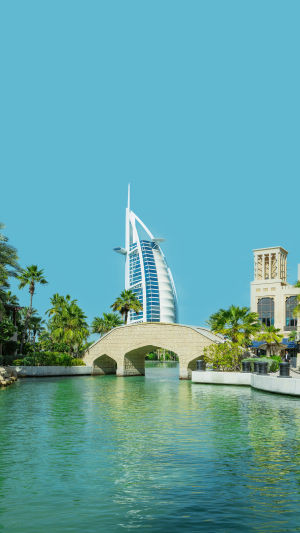
One moment, you are standing on the observation deck of the world's tallest building, gazing at a horizon that seems to curve into the future; the next, you are gliding across a salt-scented creek on a wooden boat that looks exactly as it did a century ago.
Dubai is a breathtaking contradiction—a hyper-modern metropolis built on the foundations of pearl diving and desert trade.
From the temperature-controlled luxury of its sprawling malls to the rhythmic chanting heard in its vibrant spice markets, this city offers a sensory journey that proves nothing is impossible when ambition meets the desert sun.
Dubai, United Arab Emirates
<h3>Architectural Giants and Record Breakers</h3>
The skyline of Dubai is dominated by the Burj Khalifa, a shimmering silver needle that pierces the clouds at 828 meters. Standing at its base, you can witness the Dubai Fountain, a choreographed water display that shoots streams as high as a 50-story building. Nearby, the Museum of the Future, an elliptical masterpiece of stainless steel covered in Arabic calligraphy, serves as a beacon for global innovation.
Beyond the steel and glass, the city has engineered its own coastline. The Palm Jumeirah, an artificial archipelago shaped like a palm tree, is visible from space and houses some of the most exclusive resorts on the planet. Walking along the crescent of The Palm, you can truly appreciate the scale of human ingenuity that transformed a flat coastline into a global playground.
<h3>Authentic Heritage in Al Fahidi</h3>
To find the soul of the city, head to the Al Fahidi Historical Neighborhood. Here, buildings are constructed from coral and gypsum, featuring traditional "wind towers" designed to funnel cool breezes into the courtyards below. This quiet, labyrinthine district is filled with art galleries, hidden tea houses, and museums dedicated to the nomadic lifestyle of the Bedouins.
Crossing the Dubai Creek is an essential experience. For just a few cents, you can board an Abra (a traditional water taxi) to reach the Deira side of the city. The air here thickens with the scent of frankincense and cloves as you enter the Spice Souk. Gold enthusiasts will find themselves dazzled by the nearby Gold Souk, where shop windows are draped in heavy, intricate jewelry, showcasing the city's historic title as the City of Gold.
<h3>Essential Visitor Logistics</h3>
Navigating a city spread across a desert requires a mix of high-tech transport and careful timing to avoid the midday heat.
<b>Practical Travel Information:</b>
1. Transportation: The Dubai Metro is fully automated and covers major landmarks; a "Nol" card is required, and a daily pass costs about $6. Taxis are plentiful, with a base fare of roughly $3.30.
2. Opening Hours: Malls are generally open from 10:00 AM to midnight. The Burj Khalifa observation deck opens at 8:00 AM and stays open until midnight.
3. Admission Prices: A standard ticket for the Burj Khalifa (Levels 124 & 125) costs approximately $46. Entry to the Museum of the Future is about $40.
4. Activity Costs: A desert safari including dune bashing and a traditional dinner costs between $50 and $85 per person. An Abra ride across the creek is roughly $0.30.
5. Accommodation Options: Staying in the Marina area offers great views, with mid-range hotels like Rove Dubai Marina charging $110–$160 per night. Luxury stays at Burj Al Arab can exceed $1,500 per night.
6. Food Options: Dubai offers a mix of international and local cuisine. Expect meals at casual restaurants to cost $10–$25 per person. Traditional Emirati meals at local restaurants may cost $15–$40 per person.
<h3>Desert Adventures and Dunes</h3>
No trip is complete without venturing into the Arabian Desert. As the city lights fade in the rearview mirror, the landscape transforms into a sea of undulating orange dunes. The sand here is remarkably fine, often shifting with the wind to create sharp ridges. Visitors can engage in sandboarding or experience falconry, a traditional sport that has been part of local culture for thousands of years.
As night falls in the desert, the temperature drops rapidly, and the sky becomes a canopy of brilliant stars. Traditional desert camps provide a glimpse into the past, offering camel rides and local delicacies served around a central fire. It is in this silence, away from the hum of the city's air conditioners, that you truly feel the ancient spirit of the peninsula.
<h3>Sustainable Future and Green Spaces</h3>
Despite its desert location, Dubai is investing heavily in green initiatives. The Dubai Miracle Garden features over 150 million blooming flowers arranged in stunning shapes, including a full-sized floral airplane. Meanwhile, the Sustainable City project showcases how a modern community can thrive with solar energy and water recycling. These efforts demonstrate that while the city was built on resource wealth, its eyes are firmly fixed on a sustainable and ecological future.
Dubai is a destination that constantly reinvents itself, offering a unique blend of high-octane luxury and deep-rooted tradition. Whether shopping for silk in a crowded souk or dining in a restaurant that rotates above the clouds, the city ensures every moment is cinematic. By understanding the balance between its futuristic skyline and humble coastal beginnings, you can appreciate the true magic of this desert jewel. Dubai challenges perceptions and leaves travelers with memories as bright as the gold in its markets.


