

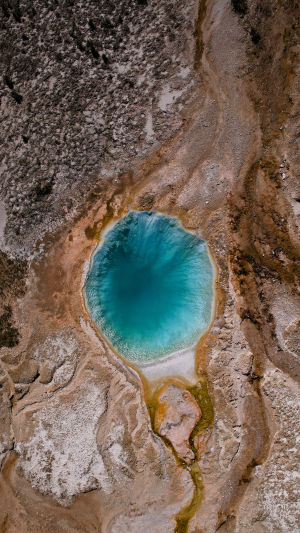
A perfect circle of turquoise water sits in the middle of a landscape that looks scorched.
The pool's edge grades from pale white mineral deposits through orange and amber to the deep blue-green center, where the water descends into a vent of unknown depth.
A thin channel of overflow runs from the pool's lower edge across the pale silica crust, staining the ground in a rust-colored line. The air above it shimmers. Nothing grows within several meters of the edge.
This is a hydrothermal feature in Yellowstone National Park, and the color, the heat, the mineral patterns, and the complete absence of ordinary ecological rules that govern everywhere else make it one of the most genuinely alien environments accessible to any visitor in North America.
Yellowstone National Park sits atop one of the largest active volcanic systems on Earth, a supervolcano whose magma chamber lies approximately 8 kilometers beneath the surface and drives the hydrothermal activity that produces the park's 10,000 thermal features, including geysers, hot springs, mud pots, and fumaroles. The park covers approximately 8,983 square kilometers across Wyoming, Montana, and Idaho, and receives approximately four million visitors per year, making careful timing and planning essential for a rewarding experience.
<h3>Getting There</h3>
Yellowstone has five entrance gates, with the primary access points being the West Entrance near West Yellowstone, Montana, and the South Entrance from Grand Teton National Park to the south.
Jackson Hole Airport in Wyoming is the closest commercial airport, located approximately 60 miles south of Yellowstone's South Entrance. Direct flights from major US cities including Denver, Salt Lake City, and Dallas operate year-round, with tickets starting from approximately $150 to $300 each way depending on origin and season.
Car rental from Jackson Hole Airport starts from approximately $60 to $90 per day and is essential for exploring the park's 466 miles of road. Salt Lake City and Denver airports offer broader flight options with lower ticket prices, with driving times to the park of approximately four and five hours respectively.
The park entrance fee is $35 per vehicle for a seven-day pass covering both Yellowstone and Grand Teton National Parks.
<h3>Key Thermal Features and Practical Costs</h3>
Yellowstone's thermal basins are distributed across the park, with the main concentrations in the Upper Geyser Basin, Midway Geyser Basin, Norris Geyser Basin, and West Thumb Geyser Basin.
1. Grand Prismatic Spring in the Midway Geyser Basin is the largest hot spring in the United States at approximately 90 meters in diameter, producing the most vivid color gradation of any thermal feature in the park. The spring is viewed from a boardwalk at ground level and from the Fairy Falls trail overlook approximately one mile from the parking area, which provides the elevated aerial perspective. Covered by park entry fee. Open year-round.
2. Old Faithful Geyser in the Upper Geyser Basin erupts approximately every 90 minutes to a height of 30 to 50 meters and is the most reliable large geyser in the park. The eruption duration and next predicted eruption time are posted at the Old Faithful Visitor Education Center. Covered by park entry fee.
3. West Thumb Geyser Basin, located directly on the shore of Yellowstone Lake, contains the specific pool type visible in this aerial image, where circular deep hot springs sit within meters of the lake edge. The boardwalk circuit takes approximately 30 minutes. Covered by park entry fee.
4. Norris Geyser Basin, the hottest and most dynamic thermal basin in the park, contains Steamboat Geyser, the world's tallest active geyser capable of erupting over 90 meters. Eruptions are irregular but have become more frequent in recent years. Covered by park entry fee.
<h3>Where to Stay</h3>
Accommodation within Yellowstone is operated by a single concessionaire and must be booked well in advance, often six months or more for peak summer season.
Old Faithful Inn, a National Historic Landmark built in 1904 from local lodgepole pine and rhyolite stone, sits directly adjacent to Old Faithful Geyser and is considered one of the finest examples of National Park rustic architecture in the United States. Rooms start from approximately $150 to $280 per night. Views of Old Faithful eruptions are available from the inn's upper balconies.
Lake Yellowstone Hotel on the shore of Yellowstone Lake provides classic lodge accommodation from approximately $180 to $300 per night. For budget travelers, Canyon Campground and other park campgrounds offer tent and RV sites from approximately $20 to $35 per night, bookable through the park reservation system.
Yellowstone rewards visitors who move slowly between the thermal basins and resist the urge to cover the entire park in a single day. Each basin has a distinct character, different water temperatures produce different microbial mats and therefore different colors, and the light on the thermal features changes dramatically between morning steam rising in cold air and the flatter midday illumination. Arrive at the basins early, walk the boardwalks in both directions, and spend time at the features that look most extraordinary rather than moving immediately to the next one. The park has 10,000 thermal features. The ones worth remembering are the ones you actually stopped at.


