

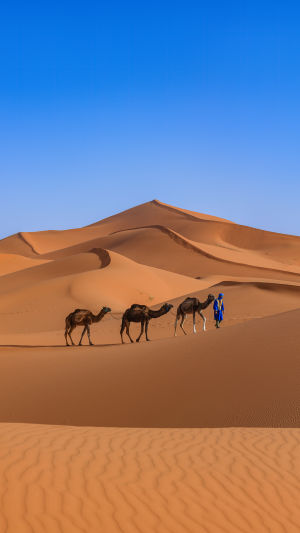
The desert is one of the most extreme environments on Earth, where vast stretches of arid land and intense heat make survival a significant challenge. Among the animals that inhabit this landscape, the camel stands out as a true master of endurance.
This remarkable animal can travel across wide open terrain where water sources are scarce, raising a simple yet fascinating question: how long can a camel survive without drinking water?
In general, a camel can survive for about seven to ten days without drinking under hot desert conditions, although this period may be longer in cooler environments. However, this is not a fixed timeframe. It varies depending on environmental conditions, food availability, and activity levels. To understand this remarkable ability, it is important to examine the specialized adaptations that make it possible.
<h3>Why Camels Can Endure Long Dry Periods</h3>
Camels are uniquely equipped for life in harsh desert environments. Their bodies are not simply strong; they are highly specialized for conserving resources.
One of the camel's greatest strengths is the way multiple adaptations work together. Rather than relying on a single survival mechanism, camels use a combination of physiological features that reduce water loss and support efficient energy use. This integrated system enables them to continue traveling even when water sources are widely separated.
As a result, camels are exceptionally well suited for endurance over long distances.
<h3>More Than an Energy Reserve</h3>
The camel has a unique adaptation that is often misunderstood. Contrary to a common misconception, it does not store water for future use. Instead, it maintains a concentrated energy reserve that helps the animal endure long periods when food is limited.
When resources become scarce, the camel gradually draws upon this stored energy to support its daily needs. During this process, small amounts of metabolic water are naturally produced, helping the animal maintain its internal balance.
When a camel has access to sufficient food, these energy reserves increase. As resources are used over time, the reserves gradually decrease. This natural cycle helps the camel adapt to challenging desert conditions.
<h3>Efficient Water Management</h3>
Camels possess several physiological adaptations that allow them to use water with remarkable efficiency. When water becomes available, a camel can consume a large quantity in a relatively short period.
The water is then utilized efficiently throughout the body, helping the animal recover from dehydration and sustain itself during long journeys between water sources.
This adaptation is particularly valuable in desert regions where access to water may be unpredictable.
<h3>Saving Every Drop</h3>
One of the most impressive aspects of camel biology is its ability to minimize water loss.
Its body is highly efficient at conserving moisture. Specialized internal processes help retain as much water as possible, allowing the animal to maintain hydration for longer periods in dry environments.
Even the respiratory system contributes to water conservation. Specialized structures within the nasal passages help recover moisture from exhaled air before it leaves the body, reducing overall water loss.
Together, these adaptations form an efficient and coordinated system that helps maintain hydration for extended periods.
<h3>How Environment and Food Influence Survival</h3>
Environmental conditions play a major role in determining how long a camel can survive without drinking.
In cooler or more humid conditions, water loss occurs more slowly, allowing longer intervals between drinking opportunities.
In hotter and drier environments, water loss increases, making access to water more critical.
Food also contributes to hydration. Many desert plants contain moisture, and by consuming these plants, camels obtain additional water through their diet. This supplementary source of hydration can help support survival when direct access to water is limited.
<h3>A Survival System Shaped by Evolution</h3>
When viewed as a whole, the camel represents a highly effective survival system. No single adaptation explains its success. Instead, its endurance results from multiple specialized features working together.
The hump's energy reserve, efficient water-conservation mechanisms, and other physiological adaptations work together to support the camel's survival in challenging environments. This combination enables the animal to travel across long desert routes with remarkable resilience and efficiency.
The camel demonstrates that survival in nature is often achieved through balance, efficiency, and adaptation.
<h3>Final Thoughts for Lykkers</h3>
Lykkers, the camel is one of nature's most extraordinary examples of adaptation to extreme environments. Its ability to conserve water, efficiently use stored energy, and reduce moisture loss allows it to flourish in conditions that would challenge many other species.
By understanding these adaptations, we gain a deeper appreciation for the remarkable ways living organisms evolve to overcome environmental challenges. The camel's success in some of the world's harshest landscapes serves as a powerful example of nature's capacity for resilience and adaptation.


