

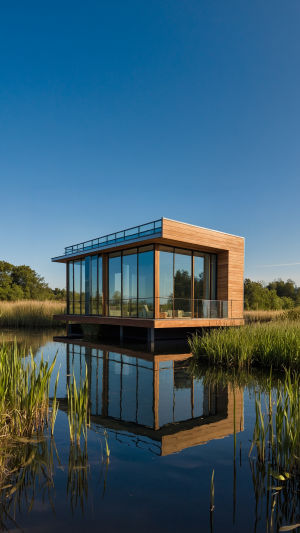
Hi, Friends! You know that feeling when you see a jaw-dropping photo of a building online, you travel all the way there, and then you stand in front of it thinking, "Wait... is this the right place?"
It is like ordering a burger that looks like a masterpiece in the ad, and getting something that looks like it fell off the tray. You are not imagining things.
There is a whole bag of tricks behind why architectural photos look so much better than the real deal.
<h3>The Camera Lies (Beautifully)</h3>
First up, let us talk about lenses. Architectural photographers almost always use wide-angle lenses, and those things are basically magic wands for buildings. They stretch space, make ceilings look taller, rooms look larger, and facades look more dramatic than your favorite action movie poster.
A hallway that is barely wide enough for two people suddenly looks like a grand palace corridor. In real life, your eyes do not work like a wide-angle lens. What you see is just... the hallway.
Then there is perspective control. Photographers use specialized tilt-shift lenses or fix things in post-processing to make sure vertical lines stay perfectly straight. No leaning, no distortion. Buildings look crisp, upright, and commanding. When you stand there in person, you are tilting your head, squinting, and the building is just kind of... there.
<h3>Lighting Is Doing All the Heavy Lifting</h3>
Professional architectural photographers do not just show up whenever. They chase what is called the "golden hour," that magical window just after sunrise or just before sunset when the light turns warm, soft, and flattering. It is basically the building's best selfie lighting. Shadows get long and dramatic, textures pop, and even the most ordinary concrete wall starts looking like a piece of fine art.
However, when you visit, say, two in the afternoon on a cloudy Tuesday? Flat light, washed-out colors, and all those gorgeous shadows have gone on vacation. The building looks about as exciting as a grocery store parking lot.
<h3>The Environment Gets a Makeover</h3>
Here is another trick people rarely notice: the surroundings. In a great architectural photo, the frame is carefully composed to exclude the unpleasant stuff, the power lines, the dumpster around the corner, the construction fence next door, and the random cars parked out front. The photographer finds the one perfect angle where all of that disappears, leaving only the building looking pristine and photogenic against a clean sky.
When you visit in person, you see the full 360-degree reality. The dumpster is very much still there. So is the construction noise, the bus stop, and the coffee cup someone left on the steps.
<h3>Post-Processing Is the Real Architect</h3>
After the shoot, the photo goes into editing software where colors get boosted, skies get replaced with dramatic clouds or deep blue gradients, blemishes get removed, and the whole image gets a mood treatment that would make any Instagram filter jealous. The final photo is less a document of a building and more a piece of creative storytelling.
This is not necessarily deceptive; it is an art form in its own right. Architectural photography is about communicating the design intent, the feeling and vision the architect had, rather than a raw snapshot of what is there. Sometimes the edited version actually captures something true about the building that reality, in its messy, imperfect way, fails to deliver on an ordinary day.
<h3>Your Brain Is Part of the Problem Too</h3>
When you look at a photo, you are focused. Nothing is competing for your attention. No traffic noise, no crowd, no temperature, no tired legs from walking around all day. The photo is a curated, distraction-free experience. Being there in person is full of sensory chaos that makes it harder to "see" the building the way the camera sees it.
Interestingly, some architects and photography experts suggest that visiting a building at the same time of day shown in its famous photo, and from the same vantage point, can genuinely change the experience. You might find the building suddenly clicks into place and looks almost as good as the photo.
So next time you feel let down by a building in person, do not blame the building entirely. Blame the golden hour, it was not showing you, the wide-angle lens you do not have, and the dumpster the photographer conveniently left out of the frame. Architectural photography is a craft that tells a story, and like all good stories, it picks and chooses what to include.
Now you know the secret, and honestly, it just makes both the photos and the buildings a little more interesting to look at!


