

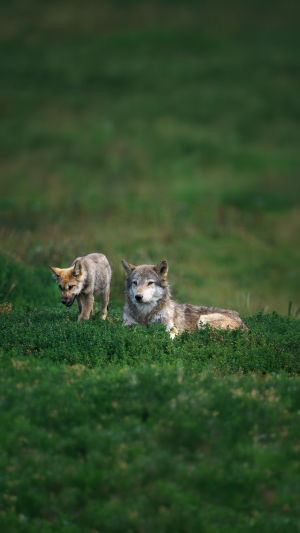
At least <b>18,000 animal species worldwide</b> are currently classified as vulnerable, endangered or critically endangered. The scale of the problem remains serious, yet the global picture is not entirely negative.
Long-term conservation work has helped several populations recover, including some wolves, whales, lizards and parrots. These examples show that protection can work when habitat, monitoring and local cooperation are maintained over time.
At the same time, many other species continue to decline because of shrinking habitats, fishing pressure, hunting and growing conflict with human activity. Endangered Species Day, observed on May 15, is therefore not only a reminder of what has already been lost, but also of what can still be protected.
<h3>Wolves Return to California</h3>
Gray wolves began naturally returning to California in 2015 after disappearing from the state for several decades.
Their recovery has been striking. Today, an estimated <b>50 to 70 wolves</b> live in California, organised into at least 10 packs.
The return of a large predator, however, has also created difficult questions for rural communities. Between 2015 and 2024, wolves were responsible for at least 142 confirmed losses among farm animals.
That figure represented only about <b>0.002% of California’s nearly seven-million-strong bovine population</b>, but the impact can still be significant for individual ranchers whose animals are affected.
The debate is increasingly focused on how livestock farming and wolf conservation can coexist.
Some ranchers have begun using nonlethal deterrents such as electric fencing and fladry — strips of brightly coloured fabric attached to fences that can discourage wolves from approaching grazing animals.
More unusual methods are also being tested, including drones equipped with loud music or other sounds designed to make pasture areas less attractive to predators. These techniques will not remove every conflict, but they offer an alternative to relying entirely on lethal control.
<h3>West African Leopards Are Declining</h3>
The outlook for leopards in West Africa is considerably more worrying.
Their population has fallen by approximately <b>50% over the past two decades</b>. Recent estimates suggest that only about 350 mature individuals remain across the region.
This steep decline led to the West African leopard population being reclassified from vulnerable to endangered.
The problem is made more serious by the fact that these animals are genetically isolated from leopard populations in Central Africa. Limited movement between the two groups means that natural recovery through interbreeding is unlikely to happen easily.
The remaining animals survive mainly in fragmented protected areas spread across 11 West African countries.
Protecting those landscapes is therefore essential. Leopards require large territories, and isolated reserves may not be enough if development, hunting or habitat destruction continues around them.
Creating safer connections between protected areas could become increasingly important for maintaining genetic diversity and allowing animals to move between remaining populations.
<h3>Rays Face an Overlooked Crisis</h3>
Sharks have long received much of the attention in marine conservation, but scientists are warning that rays are facing a major crisis of their own.
Preliminary estimates suggest that around <b>191 million rays may be killed every year</b>, approximately twice the estimated number of sharks.
About 36% of all ray species are considered threatened with extinction. Among species associated with coral reefs, the proportion rises to around <b>69%</b>.
Fishing pressure is one of the biggest threats. Rays may be targeted directly or caught unintentionally in fisheries aimed at other species.
Many coastal rays are particularly vulnerable because they live in areas where human activity and fishing are intense.
Public awareness is another challenge. Large manta rays are familiar and visually impressive, but many smaller species receive far less attention despite facing equally serious threats.
When a species attracts little public interest, it may also receive less research funding and conservation support.
<h3>Why Conservation Still Matters</h3>
The contrast between California’s wolves and West Africa’s leopards illustrates how different wildlife trends can be.
One population is expanding into landscapes where it had disappeared. Another has lost half of its numbers within only two decades.
Rays show yet another problem: a conservation crisis can develop largely outside public attention.
These examples demonstrate why protecting endangered species requires more than reacting when numbers reach critically low levels. Preventing habitat destruction, improving fisheries management, reducing conflicts with local communities and monitoring populations all need to happen much earlier.
Conservation also works best when people living alongside wildlife are part of the solution. Farmers, fishers, scientists and local communities often have to balance economic needs with the survival of threatened animals.
<b>The encouraging lesson is that wildlife can recover when protection is sustained. The warning is that success is never permanent — without continued attention, even recovering species can begin to decline again.</b>


