

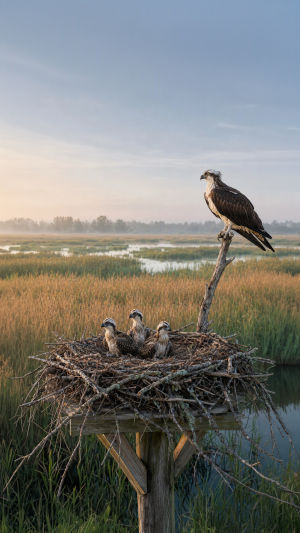
Three osprey chicks have successfully hatched at Campfield Marsh in Cumbria, marking the first confirmed breeding success for the species on an RSPB nature reserve in England since the Victorian period.
The event is particularly significant because ospreys disappeared as a breeding species from the UK in the early 20th century after years of persecution. Their return began in Scotland during the 1950s, and the population has gradually expanded since then.
Today, there are an estimated <b>316 breeding pairs across the UK</b>, with Scotland remaining their main stronghold.
The three new chicks in Cumbria are therefore part of a much broader recovery story — one that has taken decades of habitat protection, monitoring and careful management.
<h3>A Remarkable Comeback</h3>
Ospreys are large migratory birds of prey with dark brown upperparts, pale underparts and long wings that bend noticeably at the “wrist”.
Unlike many other raptors, their diet consists almost entirely of fish. They hunt over lakes, rivers and estuaries, often hovering briefly before plunging towards the water and grabbing prey with powerful talons.
British ospreys spend the winter much farther south, typically in West Africa, before returning to breeding territories from March onwards.
Their disappearance from Britain made their natural recolonisation especially remarkable. Scotland provided the first major foothold, but successful breeding has gradually spread into other parts of the country.
<h3>A Nest Built for Ospreys</h3>
Campfield Marsh sits on the southern shore of the Solway Firth, one of Britain’s largest estuaries.
The reserve combines saltmarsh, peatland, farmland and wet grassland, creating habitat for a wide variety of birds.
A specially designed osprey nesting platform had been installed there in the hope that visiting birds would eventually settle.
In spring 2026, that preparation paid off.
A male known as <b>Blue 571</b>, which had been ringed in Dumfries in 2021, paired with an unringed female after arriving at Campfield Marsh in April. The pair settled on the platform and eggs were laid between 30 April and 6 May.
Three chicks then hatched between <b>7 and 14 June</b>.
<h3>Ash, Bowness Bobbi and Beau</h3>
The chicks were fitted with identification rings in July so researchers can recognise them if they are spotted elsewhere in Britain or along their future migration routes.
Local schoolchildren helped choose their names: <b>Ash, Bowness Bobbi and Beau</b>.
The young birds are expected to leave the nest during August, although fledging is only the beginning of their independence.
For several weeks they are likely to remain around the local area while developing the skills needed to catch fish and survive without their parents.
Then comes a much greater challenge.
From September onwards, the young ospreys are expected to begin their first migration towards Africa. The journey usually takes around <b>four to six weeks</b>.
For birds making the trip for the first time, it is an extraordinary test of navigation and endurance.
<h3>Why Ringing Matters</h3>
The coloured leg rings fitted to the Campfield Marsh chicks allow researchers and birdwatchers to identify individuals without recapturing them.
A sighting years later can reveal where a bird spends the summer, whether it survived migration and even where it eventually chooses to breed.
This is particularly useful for ospreys because many show strong loyalty to breeding areas and partners.
If Ash, Bowness Bobbi or Beau eventually return to Britain, their rings could help researchers trace the next stage of this recovery.
Cumbria already has experience with this type of monitoring. More than 100 osprey chicks have previously been ringed at Foulshaw Moss, providing valuable information about movements between Britain and wintering grounds farther south.
<h3>Habitat Makes the Difference</h3>
The success at Campfield Marsh is not simply the result of putting up a nesting platform.
Ospreys need reliable fishing areas, relatively undisturbed nesting sites and suitable structures capable of supporting their large nests.
The wider wetland environment around the Solway Firth provides exactly the type of landscape that can support these requirements.
Managing water levels, maintaining wetlands and protecting quieter areas also benefits many other species, including wintering waders and waterfowl.
The osprey nest therefore represents one highly visible result of much broader habitat management.
<h3>Where to See Ospreys</h3>
Ospreys remain relatively uncommon in Britain, but sightings are now possible at an increasing number of locations.
Scotland still provides some of the most reliable opportunities during the breeding season, including Loch of Kinnordy and Loch Lomond. Campfield Marsh is also encouraging visitors to look for its new osprey family during August before migration begins.
Anyone hoping to watch them should use established viewing areas and avoid approaching nesting sites.
A distant view of an osprey diving for a fish is more than enough to understand why their return has attracted so much attention.
<b>Three chicks in a single nest may sound like a small event, but for a species that disappeared from Britain little more than a century ago, it represents another important step in an extraordinary recovery.</b>


