

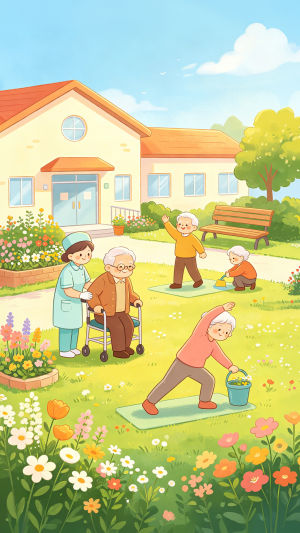
Outdoor exercise can be a valuable part of healthy aging when activities are matched to older adults’ abilities, health status, and care needs.
In nursing homes and other care settings, suitable outdoor activities may include walking, seated exercises, gentle stretching, supported movements, and gardening.
The purpose is not to achieve strenuous workouts. A well-planned outdoor activity program should promote regular movement while prioritizing comfort, appropriate support, and individual functional ability.
<h3>Why Outdoor Exercise Matters</h3>
Regular physical activity can help older adults maintain physical function, strength, flexibility, endurance, and balance. It can also support the ability to participate in everyday activities and maintain independence.
“Older adults who do any amount of physical activity gain some health benefits.” — National Heart, Lung, and Blood Institute.
Outdoor exercise provides an opportunity to combine physical activity with time outside and meaningful social interaction. The type, duration, and intensity of activity should be adjusted according to each resident’s capabilities and care plan.
<h3>Gentle Outdoor Activities</h3>
<b>Walking</b>
Short walks on smooth, accessible paths can support mobility and endurance. Residents can use appropriate mobility aids when prescribed and receive assistance when necessary.
<b>Seated Exercises</b>
Chair-based movements such as shoulder rolls, arm raises, seated marching, and gentle leg movements can provide accessible physical activity for residents who have difficulty standing or walking.
<b>Gentle Stretching</b>
Controlled movements involving the shoulders, arms, ankles, and legs can help maintain flexibility and range of motion. Movements should remain comfortable and should never be forced.
<b>Supported Standing</b>
Residents who can safely stand may perform simple movements such as controlled weight shifting, heel raises, and sit-to-stand exercises. These activities should be performed with appropriate support and supervision.
<b>Gardening</b>
Watering plants, planting, arranging containers, and caring for raised beds can combine light physical activity with a meaningful task. Gardening can be modified for seated participation or for residents with limited mobility.
<h3>Outdoor Exercise for Wheelchair Users</h3>
Wheelchair users can participate in suitable activities such as seated upper-body movements, reaching exercises, and gentle ball activities.
Outdoor areas should provide firm, stable, accessible surfaces with sufficient space for safe wheelchair movement. Activities involving standing or walking should only be included when they are appropriate for the resident and supported by suitable assistance.
<h3>Safety Considerations</h3>
Outdoor exercise should be planned around the resident’s health, functional ability, and care requirements.
- Choose level, unobstructed, accessible surfaces.
- Check weather conditions and provide shade when necessary.
- Follow the resident’s individual hydration and care plan.
- Allow adequate rest periods.
- Use appropriate footwear and prescribed mobility aids.
- Provide assistance or supervision according to individual needs.
- Stop the activity if the resident becomes unwell, dizzy, unusually tired, or uncomfortable.
Residents with significant health conditions, mobility limitations, or other concerns may need an individualized activity plan developed with an appropriately qualified healthcare professional.
Outdoor exercise can provide older adults with meaningful opportunities to remain physically active while spending time outside. Walking, seated exercises, stretching, supported movements, and gardening can be adapted to different functional abilities.
The most appropriate approach is consistent, purposeful movement that respects each resident’s health, comfort, abilities, and level of independence.


