
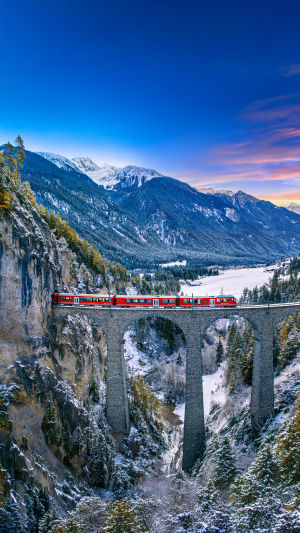
Welcome back, everyone. You've probably seen the Landwasser Viaduct in a dozen Instagram posts without realizing it.
That sweeping curved stone bridge, 65 meters high, tucked into a narrow valley in the Swiss Alps. Most people think you need a helicopter or a full day of alpine hiking to see it properly.
Not true. You can stand right next to it, ride over it, and even walk beneath it, all within a few hours.
<h3>Why this viaduct deserves a stop</h3>
The Landwasser isn't just another pretty bridge. It's a 136-meter-long curved structure that carries the Rhaetian Railway's Albula line, a UNESCO World Heritage route since 2008. What makes it special is the way it dives straight into a mountain. The viaduct ends at the mouth of the Landwasser Tunnel, so trains disappear into solid rock the second they cross.
Built between 1901 and 1902, it's held up with twelve arches, each about 20 meters wide. When a train rolls across, you get that classic shot of red carriages against gray stone and green forest. That's the moment people come for.
<h3>Ride the train, don't just watch it</h3>
The easiest way to experience the viaduct is from inside a train. The Bernina Express and the Glacier Express both use this line, but you don't need a fancy panoramic train. Standard regional trains on the Rhaetian Railway run the same route, and they cost far less. A regular ticket from Chur to St. Moritz runs around 30 to 40 USD one way.
You'll cross the viaduct about 20 minutes after leaving Chur, right before the stop at Filisur. Sit on the left side of the train heading toward St. Moritz. You'll feel the curve and catch a glimpse of the valley below, but honestly, the best view is from outside.
Landwasser Viaduct
<h3>Get below for the money shot</h3>
Head to the village of Filisur, which sits about 20 minutes by train from the viaduct. From the Filisur station, it's a 25-minute walk on a paved path down to the valley floor. The trail is marked with brown signs pointing to "Landwasser Viadukt." Once you're below, you'll be standing directly under the massive arches, looking straight up at the stonework. There's a small viewing platform near the tunnel entrance where photographers set up tripods.
The classic angle is from the north side, where you can frame the full curve and the tunnel mouth in one shot. If you're there in the late afternoon, the light hits the stone nicely, and you'll have the place mostly to yourself.
<h3>Plan your visit like a local</h3>
Time your trip around the train schedule, because the viaduct is only exciting when a train crosses it. Trains pass roughly every 30 to 60 minutes, so check the Rhaetian Railway timetable before you go. The walk down takes about 25 minutes, and the walk back up to Filisur is a steady climb, plan for 35 minutes on the return. Bring sturdy shoes, the path is paved but a bit rough in spots. There's no ticket needed to view the viaduct from below, it's public land.
If you want a higher perspective, the Landwasser Viewpoint near the Alvaneu side gives you an elevated look, but it requires a longer hike of about 90 minutes from the nearest bus stop. For most people, the Filisur walk is the sweet spot.
So pack a light day bag, grab a regional train ticket, and give yourself a half day for this stop. You'll see a UNESCO World Heritage site up close, snap the photo that actually matches the hype, and still have time to catch an afternoon train onward. Worth every step.


