

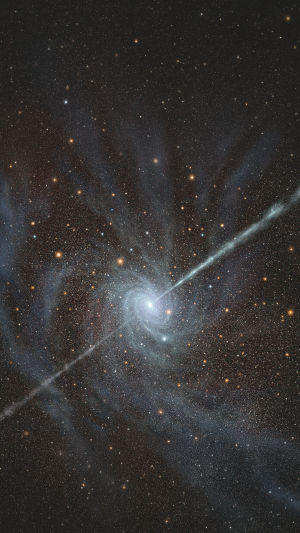
Look at a spiral galaxy, and its shape can seem almost too organized to be natural. Long curved arms extend from a bright central region, creating one of the most recognizable forms in astronomy.
Yet these arms are not fixed lines of stars, but patterns created by the movement of stars, gas, dust, and gravity across a vast rotating system. So why do some galaxies develop these distinctive arms while others do not?
<h3>Rotation Helps Create the Shape</h3>
A major part of the story is <b>rotation</b>. Spiral galaxies rotate around their centers, with stars and other material following orbital paths. Because different parts of a galaxy can move at different speeds, material does not simply rotate as one rigid structure.
The inner regions generally complete an orbit quicker than regions farther out. This differential rotation stretches structures within the galaxy and helps create the curved appearance associated with spiral patterns.
However, the spiral arms are not simply permanent rows of stars traveling around the galaxy. They are better understood as regions where material becomes more concentrated as the galaxy rotates.
<h3>Spiral Arms Are Regions of Higher Density</h3>
One of the most important ideas for understanding spiral galaxies is the concept of a <b>density wave</b>. A spiral arm can be thought of as a region of greater density moving through the galactic disk.
As gas passes through these denser regions, it can become compressed. Under suitable conditions, this compression can contribute to the formation of new stars.
This helps explain why spiral arms often appear especially bright. Young, hot stars can shine strongly, making the arms easier to see. Gas and dust associated with these regions also contribute to the distinctive appearance seen in many spiral galaxies.
The arms therefore represent an active part of the galaxy rather than simply being decorative structures made of permanently grouped stars.
<h3>Gravity Keeps Everything Together</h3>
Gravity provides the underlying force that holds a galaxy together. Stars, gas, dust, and other material all contribute to the gravitational environment in which the galaxy rotates.
Without gravity, the material making up a galaxy would not remain organized around a common center. At the same time, the rotating motion prevents everything from simply falling directly inward.
The balance between gravity and orbital motion helps maintain the broad disk structure in which spiral patterns can develop. The exact shape and behavior of a galaxy depend on many factors, so gravity alone does not explain why every galaxy becomes spiral-shaped.
<h3>Not Every Galaxy Becomes a Spiral</h3>
The universe contains several broad galaxy shapes, and spiral structure is only one possibility. Some galaxies have smooth, rounded appearances, while others have much less organized structures.
Why does this happen? Galaxy formation and evolution depend on factors such as the amount of gas present, the galaxy's history, its rotation, and interactions with neighboring galaxies.
A galaxy with relatively little cold gas may have fewer opportunities for the ongoing star formation commonly associated with prominent spiral arms. Other galaxies can experience changes in their structure over time as gravity affects their surroundings. This variety is one reason astronomers do not treat spiral structure as the default shape for all galaxies.
<h3>Bars Can Change Spiral Patterns</h3>
Some spiral galaxies have another striking feature: a <b>bar-shaped structure</b> crossing their central region. Instead of spiral arms beginning directly around a roughly circular central area, the arms can extend from the ends of this elongated bar.
These galaxies are called barred spiral galaxies. The bar is not a separate object placed inside the galaxy. It is made from stars and is part of the galaxy's overall structure.
Bars can influence how material moves through the inner parts of a galaxy and can play a role in how gas is redistributed. This makes barred spirals an especially interesting example of how different structures can develop within the same rotating galactic disk.
<h3>How New Stars Highlight the Arms</h3>
Spiral arms are often associated with areas of active star formation. When gas becomes compressed in dense regions of a galactic disk, conditions can become suitable for clouds of gas to collapse and form stars.
The brightest young stars do not remain unchanged forever. As they age, their contribution to the visible appearance of the arms changes. Meanwhile, the density pattern itself can continue moving through the galaxy.
This means a spiral galaxy can maintain its recognizable structure even though the individual stars making up the visible pattern are constantly changing.
Spiral galaxies get their distinctive appearance from a combination of rotation, gravity, material distribution, and changing patterns of density within their disks. Their arms are not rigid structures containing the same stars forever. Instead, they are dynamic regions where material becomes more concentrated and where new stars can form.
The result is a galaxy that looks organized from a distance while remaining constantly active on enormous scales. That combination of motion and structure is what makes spiral galaxies some of the most fascinating objects to observe in the night sky.


