

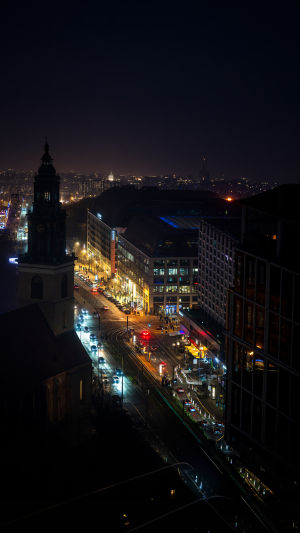
For Lykkers drawn to the elevated night scene in the image, Budapest offers a particularly suitable city break.
Dense central streets, historic towers, illuminated buildings, tram lines, and streams of vehicle lights create the same layered urban atmosphere.
Rather than racing between famous landmarks, base yourself around District V and spend two evenings seeing central Budapest from different heights. One night can focus on the illuminated streets around Deák Ferenc Square and St. Stephen Basilica, while the second moves toward the Danube for a broader city panorama. Two nights are enough, although three provide useful flexibility if cloudy weather affects visibility.
Budapest
<h3>Watch the Lights Come On</h3>
The best Budapest night view begins before complete darkness. Starting around sunset lets you watch streetlights, buildings, and traffic gradually become more prominent while the sky still has enough light to define the skyline.
<b>Begin around Deák Ferenc Square</b>
Deák Ferenc Square makes an efficient starting point because metro lines M1, M2, and M3 meet here. It also places you within an easy walk of St. Stephen Basilica, the Danube, and several central streets that remain lively after sunset.
Arrive around 45 minutes before sunset and walk toward the basilica rather than immediately taking transport elsewhere. Allow about one hour for this section. The distance is short, but the purpose is to experience the changing light rather than cover kilometres.
A single BKK ticket costs HUF 500, while a 24-hour travelcard costs HUF 2,750 and covers unlimited journeys on most regular Budapest public transport. The airport express requires a separate ticket. If you plan to make six or more regular journeys in one day, the travelcard becomes the more convenient choice.
For photography, wait until roughly 20 to 30 minutes after sunset. This is often more useful than waiting for a completely black sky because building outlines remain visible while vehicle lights already create strong lines through the streets.
<b>Add one elevated viewpoint</b>
St. Stephen Basilica provides a practical way to change perspective without travelling far across Budapest. Its panoramic terrace rises about 65 metres above ground level and offers a 360-degree view over the central city.
Allow approximately 45 minutes for the panorama. Instead of concentrating only on distant landmarks, look downward toward the illuminated street grid. That perspective is much closer to the image, where the visual interest comes from streets, traffic, rooftops, and towers layered at different distances.
Opening hours vary by period, so check the basilica official visitor information for your chosen day rather than assuming evening access is always available. If the terrace closes before darkness during your visit, go up during the late afternoon and continue the street route after sunset.
From the basilica, the Danube is roughly a 10 to 15-minute walk. Do not add another distant viewpoint on the same evening. One elevated panorama followed by a relaxed central walk produces a more coherent experience.
<h3>Give Night Two a New View</h3>
Repeating the same city-center route adds little. For your second evening, move toward the river, where Budapest opens into a wider landscape and illuminated architecture reflects across the water.
<b>Walk the Danube after sunset</b>
Begin around the Pest riverfront and allow 60 to 90 minutes for an unhurried walk. The river creates longer sightlines than the compact streets around Deák Ferenc Square, so the second evening feels noticeably different.
For a higher panorama, cross to the Buda side and continue toward Castle Hill. Budapest public transport makes this easy to combine with walking, and you can decide how much elevation to add depending on your energy.
If photography matters, a phone or camera performs better when held against a stable surface rather than relying heavily on digital zoom. For scenes resembling the image, include part of an illuminated street in the foreground rather than photographing only distant buildings. Traffic then becomes part of the composition instead of visual clutter.
Give yourself at least two hours between sunset and dinner. Constantly checking the time works against the main advantage of Budapest at night: many worthwhile views appear naturally while walking between larger landmarks.
<b>Stay central and budget sensibly</b>
District V is the strongest base for this particular trip because much of the evening route becomes walkable. The adjoining parts of District VI are another practical option if accommodation is better value.
Comfortable central rooms often fall around HUF 40,000–60,000 per night, although rates vary substantially with season, weekday, and booking date. Two people sharing a room can reasonably plan around HUF 90,000–140,000 per person for a two-night city break, excluding travel to Budapest. This allows for accommodation, local transport, meals, one paid viewpoint, and everyday expenses without requiring an expensive itinerary.
September and early October are particularly convenient for this style of trip. Darkness arrives early enough to enjoy illuminated streets without staying out extremely late, while evenings are generally more comfortable for extended walking than in midwinter.
The main planning mistake is collecting too many viewpoints. Three elevated locations in one evening may sound efficient, but queues, transport, entrances, and walking quickly consume the best light. Choose one viewpoint, one neighborhood, and one substantial walk each night.
For Lykkers, Budapest works because its night scenery is not confined to a single postcard landmark. Stay centrally for two nights, begin around Deák Ferenc Square before sunset, see the street grid from above, and reserve the Danube for night two.


