

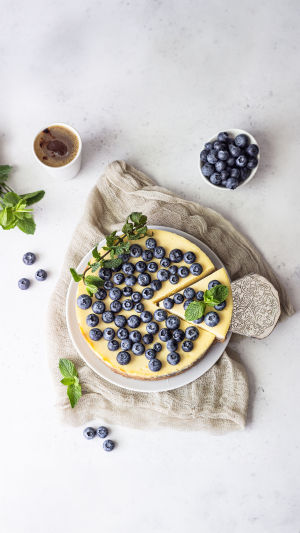
A homemade blueberry cheesecake brings together three textures that work well together: a crisp biscuit crust, a rich and creamy filling, and a sweet blueberry topping.
Although cheesecake may look like a dessert reserved for special occasions, it is manageable to prepare at home with a little planning, mostly by allowing enough time for the cake to cool and set. It makes an inviting dessert for family gatherings, celebrations, or a relaxed weekend treat.
<h3>Ingredients</h3>
The cheesecake has three parts, and the crust needs just two ingredients:
- 200 g digestive biscuits or plain sweet biscuits
- 85 g unsalted butter, melted
The filling relies on softened cream cheese and room-temperature eggs:
- 680 g cream cheese, softened
- 200 g granulated sugar
- 180 g sour cream
- 3 large eggs, at room temperature
- 1 teaspoon vanilla extract
- 1 tablespoon lemon juice
- 1 tablespoon all-purpose flour
The topping works with fresh or frozen berries:
- 250 g blueberries, fresh or frozen
- 50 g granulated sugar
- 1 tablespoon lemon juice
- 1 teaspoon cornstarch
- 1 tablespoon water
This makes 10 to 12 servings. Allow about 30 minutes of preparation, 60 to 75 minutes of baking and at least 4 hours of chilling.
<h3>Prepare the Biscuit Crust</h3>
Start with the base, which bakes briefly before the filling goes in:
1. Preheat the oven to 160°C. Lightly grease a 20–23 cm springform pan and line the base with baking paper if desired.
2. Crush the biscuits into fine crumbs in a food processor, or in a sealed bag with a rolling pin.
3. Stir the crumbs and melted butter together in a bowl until the mixture resembles damp sand.
4. Press the crumbs firmly and evenly into the pan, using the flat base of a glass.
5. Bake for 8–10 minutes, then let the crust cool while you prepare the filling.
<h3>Make the Creamy Filling</h3>
The filling comes together in one large mixing bowl:
6. Beat the softened cream cheese on low to medium speed until smooth, scraping down the sides as needed.
7. Add the sugar and mix until incorporated.
8. Blend in the sour cream, vanilla extract, lemon juice, and flour.
9. Add the eggs one at a time, mixing gently after each addition.
10. Pour the filling over the cooled base, smooth the surface with a spatula and tap the pan lightly to release large air bubbles.
Avoid beating the mixture excessively, as incorporating too much air can contribute to cracks during baking.
<h3>Bake the Cheesecake Carefully</h3>
Gentle baking and gradual cooling help keep the surface smooth:
11. Bake on the middle rack for 60–75 minutes, until the edges look set and the center still has a slight wobble.
12. Turn off the oven and leave the cheesecake inside with the door slightly open for about 30 minutes.
13. Let it cool to room temperature, then cover and refrigerate for at least 4 hours, preferably overnight.
Cooling it slowly avoids the sudden temperature changes that can cause cracks. Chilling then firms up the filling, making the cheesecake easier to slice neatly.
<h3>Cook the Blueberry Topping</h3>
The topping is cooked on the stove while the cake chills:
14. Heat the blueberries, sugar, and lemon juice in a small saucepan over medium heat for 5–8 minutes, stirring gently, until the fruit softens and turns syrupy.
15. Mix the cornstarch with the water until smooth, stir it into the pan and cook for another 1–2 minutes, stirring, until the sauce thickens.
16. Let the topping cool completely, then spread it over the chilled cheesecake shortly before serving.
For an attractive finish, reserve a few whole blueberries to scatter across the top.
<h3>Tips for a Smooth Finish</h3>
Room-temperature ingredients are especially helpful when preparing cheesecake. Cold cream cheese can leave lumps, while evenly softened ingredients blend more easily. Mixing on a lower speed also helps keep the filling smooth.
Most of the work in this cheesecake is waiting rather than mixing. Make it the day before serving for easier preparation and neater slices, then add the blueberry topping just before serving so the fresh fruit balances the richness of the filling.


